

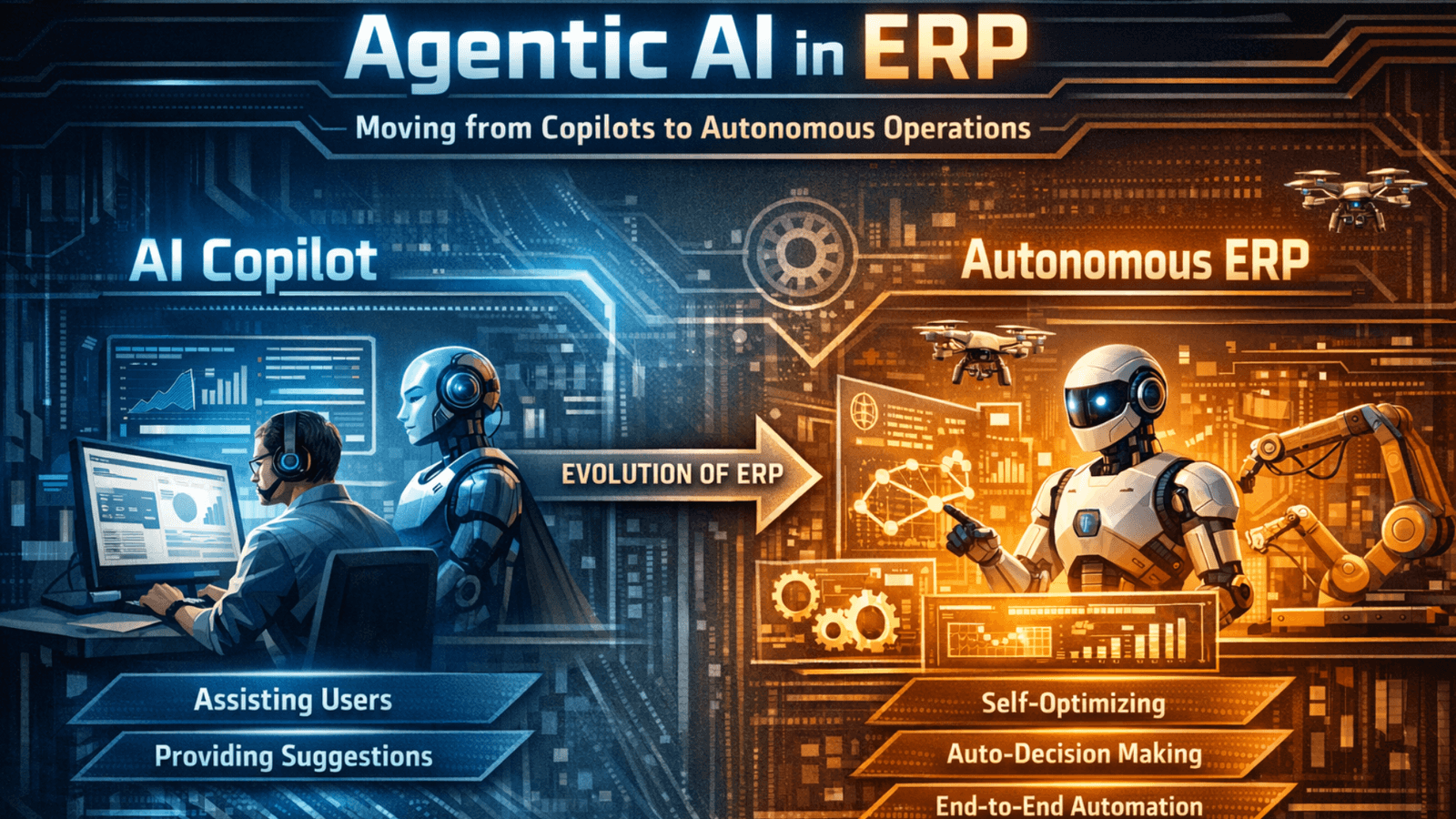
Agentic AI in ERP: Moving from Copilots to Autonomous Operations
Agentic AI ERP is rapidly reshaping how enterprise systems operate. Traditional ERP platforms were designed primarily to record transactions and enforce business processes. However, with the rise of AI agents in ERP, these systems are evolving beyond passive record keeping toward intelligent operational platforms capable of executing tasks autonomously.
This shift from rule-based ERP AI automation to intelligent agents represents one of the most significant transformations in enterprise technology. Organizations are moving from basic automation and AI copilots toward systems where AI agents can analyze data, make operational decisions within defined boundaries, and execute workflows across enterprise systems.
The Early Stage: ERP Automation
Before the rise of artificial intelligence, most ERP systems relied heavily on rule-based automation. These automations were designed to streamline repetitive processes and improve operational efficiency.
Typical examples of ERP automation include:
-
Automated invoice posting
-
Scheduled financial reporting
-
Inventory replenishment triggers
-
Workflow-based approval processes
-
Data synchronization between systems
These capabilities significantly improved productivity and reduced manual work. However, traditional ERP AI automation was limited by predefined logic. Systems could only execute tasks that were explicitly programmed.
For example, an automated invoice matching process might compare purchase orders and receipts. If the values match, the invoice is approved automatically. If not, the system simply flags an exception for manual review.
While effective, this approach has limitations:
-
Automation cannot interpret complex business context
-
Exception handling still requires human intervention
-
Cross-system coordination is difficult
-
Decision making remains largely manual
As organizations expanded their digital operations, it became clear that ERP systems needed a more intelligent layer capable of assisting users in real time.
The Next Evolution: AI Copilots in ERP
The introduction of AI copilots marked a significant advancement in enterprise technology. Instead of relying solely on rules, ERP systems began integrating generative AI and machine learning to support users in decision-making and operational tasks.
AI copilots function as intelligent assistants embedded within ERP interfaces. They help users interpret data, generate insights, and perform actions more efficiently.
Common capabilities of ERP copilots include:
-
Natural language queries for financial or operational data
-
Automated report generation
-
AI-assisted forecasting and analytics
-
Recommendations for process improvements
-
Contextual assistance within ERP workflows
For example, a finance manager could ask an ERP copilot:
“Show me the top overdue invoices and recommend collection actions.”
The system could analyze payment history, identify high-risk accounts, and suggest next steps.
This stage significantly improves usability and decision support. However, copilots still rely heavily on human initiation. They assist users, but they rarely execute complex workflows independently.
In other words, copilots make ERP systems smarter, but they do not yet make them autonomous.
The Shift Toward Agentic AI ERP
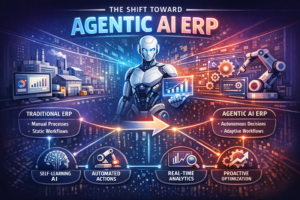
The next phase in enterprise technology introduces AI agents capable of executing operational tasks within ERP systems. This concept is known as Agentic AI ERP.
Agentic AI refers to systems that can:
-
Understand objectives
-
Plan actions to achieve those objectives
-
Interact with multiple systems
-
Execute workflows automatically
-
Adapt based on outcomes and feedback
Unlike copilots that respond to prompts, AI agents in ERP operate with a defined goal and carry out tasks across multiple steps.
For example, consider a procurement scenario.
Instead of merely recommending actions, an AI agent could:
-
Detect low inventory levels.
-
Analyze supplier performance and pricing trends.
-
Generate a purchase order.
-
Send the order for approval based on company policy.
-
Track supplier confirmation and update delivery schedules.
The system performs these tasks autonomously while maintaining governance and auditability.
This shift represents a fundamental change in how ERP systems operate.
ERP is no longer just a system where work is recorded.
It becomes a system where work gets done.
How AI Agents Work Within ERP Systems
AI agents typically operate through an orchestration layer that integrates ERP systems with data sources, APIs, and workflow engines.
A typical Agentic AI ERP architecture includes:
-
ERP Core System
Financials, supply chain, inventory, and operational data. -
Integration Layer
Connects ERP with CRM, e-commerce platforms, logistics systems, and external services. -
AI Decision Layer
Machine learning models analyze data patterns and operational signals. -
Agent Orchestration Engine
AI agents coordinate workflows across systems and execute tasks. -
Governance and Controls
Policies, approvals, and audit trails ensure compliance and accountability.
Within this framework, AI agents in ERP can interact with data, trigger workflows, and perform operational actions within defined business rules.
High-Impact Use Cases for Agentic AI ERP
The value of ERP AI automation increases dramatically when AI agents are applied to operational processes with frequent exceptions and high transaction volumes.
Finance and Accounting
AI agents can support financial operations by:
-
Automating reconciliation processes
-
Detecting anomalies in financial transactions
-
Coordinating invoice exception handling
-
Monitoring cash flow risks
This reduces manual review cycles and accelerates financial close processes.
Supply Chain Management
Supply chains involve constant monitoring and coordination across suppliers, warehouses, and logistics partners.
AI agents can help by:
-
Identifying inventory shortages
-
Monitoring supplier performance
-
Automatically adjusting replenishment strategies
-
Managing shipment disruptions
These capabilities improve responsiveness and operational resilience.
Order-to-Cash Operations
In customer operations, AI agents can manage complex workflows such as:
-
Monitoring credit risk and payment behavior
-
Resolving order exceptions
-
Coordinating customer communications
-
Tracking invoice disputes
This improves cash collection cycles and customer satisfaction.
Operational Decision Support
AI agents can also act as operational coordinators that continuously analyze business data and trigger actions when needed.
Examples include:
-
detecting unusual demand patterns
-
monitoring operational bottlenecks
-
identifying process inefficiencies
These insights allow organizations to respond to issues before they escalate.
The Importance of Governance in Agentic ERP

While agentic AI ERP offers powerful automation capabilities, organizations must implement strong governance frameworks.
Autonomous systems must operate within clearly defined boundaries. Key governance components include:
-
Human-in-the-loop approvals for critical decisions
-
Audit trails documenting agent actions
-
Access controls for system permissions
-
Policy-based decision rules
Without these controls, automation risks introducing operational errors or compliance issues.
Successful organizations treat agentic AI as controlled autonomy, not unrestricted automation.
The Future of ERP AI Automation
As AI capabilities continue to evolve, ERP systems will increasingly function as intelligent operational platforms rather than static transaction systems.
Several trends will drive this transformation:
-
Expansion of AI agents across enterprise workflows
-
Integration of ERP with AI-driven planning systems
-
Continuous monitoring of operational performance
-
Autonomous optimization of business processes
Over time, organizations will build digital workforces inside ERP environments, where AI agents collaborate with human employees to manage operations more efficiently.
Conclusion
The evolution of ERP technology is entering a new phase.
Traditional automation improved efficiency by executing predefined rules. AI copilots enhanced decision-making by assisting users with insights and recommendations. Now, Agentic AI ERP introduces intelligent agents capable of executing operational tasks autonomously.
By combining ERP AI automation, data intelligence, and controlled autonomy, organizations can transform ERP systems into platforms that actively drive business operations.
The future ERP environment will not only record transactions but also coordinate workflows, resolve exceptions, and continuously optimize processes.
For organizations willing to adopt this shift, AI agents in ERP represent one of the most significant opportunities in enterprise technology today.