

Building Seed-to-Sale Visibility and Regulatory Confidence in ERP
ERP Compliance for Regulated Industries: Achieving Seed-to-Sale Traceability in Dynamics 365
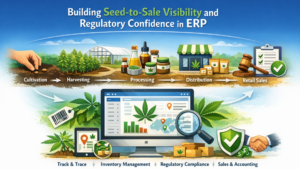
Highly regulated industries do not measure ERP success by system uptime. They measure it by audit outcomes.
ERP compliance for regulated industries requires more than financial controls. It demands seed-to-sale traceability, defensible regulatory reporting, and structured audit readiness built directly into the system architecture.
This case illustrates how a regulated manufacturer transformed Microsoft Dynamics 365 Finance & Operations into a compliance-grade platform capable of delivering end-to-end inventory traceability and executive-level compliance analytics.
Regulatory Complexity Requires Structured ERP Compliance
The organization operates in a manufacturing environment where regulatory scrutiny is constant. Every unit must be traceable from origin through transformation and final sale.
Inventory traceability is not an operational preference. It is a statutory obligation.
Regulators require:
-
Complete seed-to-sale traceability
-
Accurate regulatory reporting
-
Reproducible audit trails
-
Controlled ERP data governance
Microsoft Dynamics 365 Finance & Operations served as the operational backbone. However, while the ERP system supported financial processing and inventory control, standard reporting structures were insufficient for deep regulatory reporting requirements.
Manual spreadsheets began supplementing ERP outputs. Over time, this approach introduced risk. Data fragmentation weakened audit readiness and increased compliance exposure.
ERP compliance for regulated industries cannot rely on offline reconciliation.
The Core Challenge: Embedding Seed-to-Sale Traceability in ERP
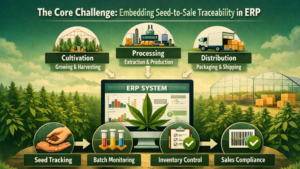
The organization’s primary objective was clear: establish full seed-to-sale traceability directly within Microsoft Dynamics 365 Finance & Operations.
However, standard inventory reports did not provide lifecycle-level visibility. Product movement across creation, transfer, transformation, and disposition required structured reporting logic beyond out-of-the-box capabilities.
Key gaps included:
-
Incomplete inventory traceability mapping
-
Manual regulatory reporting preparation
-
Limited real-time compliance analytics
-
Inconsistent access to traceability data
-
Delayed audit response cycles
The solution required ERP-native reporting that ensured:
-
Built-in audit readiness
-
Strong ERP data governance
-
Structured regulatory reporting
-
Scalable system performance
In regulated industries, traceability must be systemic. It cannot depend on individual user intervention.
Strategic Approach: Extending ERP Instead of Adding Risk
Rather than implementing an external compliance platform, the decision was made to strengthen ERP compliance within Microsoft Dynamics 365 Finance & Operations itself.
This approach protected:
-
A single source of truth
-
Financial-to-inventory data integrity
-
Transactional audit continuity
-
Long-term scalability
Custom Seed-to-Sale SSRS reporting frameworks were developed directly within the ERP architecture.
These reports captured:
-
Inventory origination events
-
Batch-level movements
-
Transformation transactions
-
Final sale and disposal records
By embedding seed-to-sale traceability inside ERP, the organization eliminated synchronization risk between systems.
ERP compliance for regulated industries must minimize architectural fragmentation.
Reporting Architecture Designed for Audit Readiness
Compliance, finance, and operations stakeholders participated in structured requirement workshops. Regulatory obligations were translated into detailed reporting logic.
Each Seed-to-Sale SSRS report was designed to:
-
Preserve transactional lineage
-
Maintain relational data integrity
-
Enable drill-down traceability
-
Support reproducible regulatory reporting
Validation cycles were rigorous. Reports were reconciled against live ERP transactions to confirm accuracy.
This structured validation strengthened audit readiness before regulatory review occurred.
Role-based security controls ensured sensitive compliance reporting remained restricted to authorized personnel.
ERP data governance was reinforced at the reporting layer.
Strengthening ERP Data Governance and Compliance Analytics
A critical transformation occurred in data governance maturity.
By embedding regulatory reporting within Microsoft Dynamics 365 Finance & Operations:
-
Manual spreadsheets were eliminated
-
Offline reconciliations were reduced
-
Reporting accuracy improved
-
Audit preparation time decreased
To enhance executive oversight, compliance analytics were layered using Microsoft Power BI.
Compliance dashboards provided:
-
Inventory traceability heatmaps
-
Movement trend analysis
-
Regulatory performance indicators
-
Exception tracking visibility
Importantly, compliance analytics did not operate outside ERP controls. They were directly sourced from validated ERP data structures.
This alignment preserved both compliance integrity and executive confidence.
Operational Outcomes of ERP Compliance Integration
The strengthened ERP compliance framework delivered measurable results:
-
Complete seed-to-sale traceability within ERP
-
Faster regulatory reporting generation
-
Improved audit readiness posture
-
Reduced manual compliance workload
-
Increased cross-functional data confidence
-
Scalable reporting performance
Compliance shifted from reactive documentation to proactive system capability.
Microsoft Dynamics 365 Finance & Operations evolved from a transactional platform into a regulatory assurance engine.
Why ERP Compliance Architecture Matters
In regulated industries, compliance failures rarely stem from missing features. They stem from fragmented data models, inconsistent reporting logic, and weak ERP data governance.
ERP compliance for regulated industries must be architected deliberately.
This case demonstrates that seed-to-sale traceability and regulatory reporting excellence can be achieved without introducing parallel systems or unnecessary complexity.
When ERP architecture aligns with operational workflows:
-
Inventory traceability becomes systemic
-
Audit readiness becomes sustainable
-
Regulatory reporting becomes defensible
-
Compliance analytics become actionable
The result is not simply better reporting.
It is institutional confidence.
For regulated manufacturers, ERP compliance is not an enhancement. It is infrastructure.