

Included or Metered? The Line Inside Copilot Extensibility
By DAX Software Solutions ·
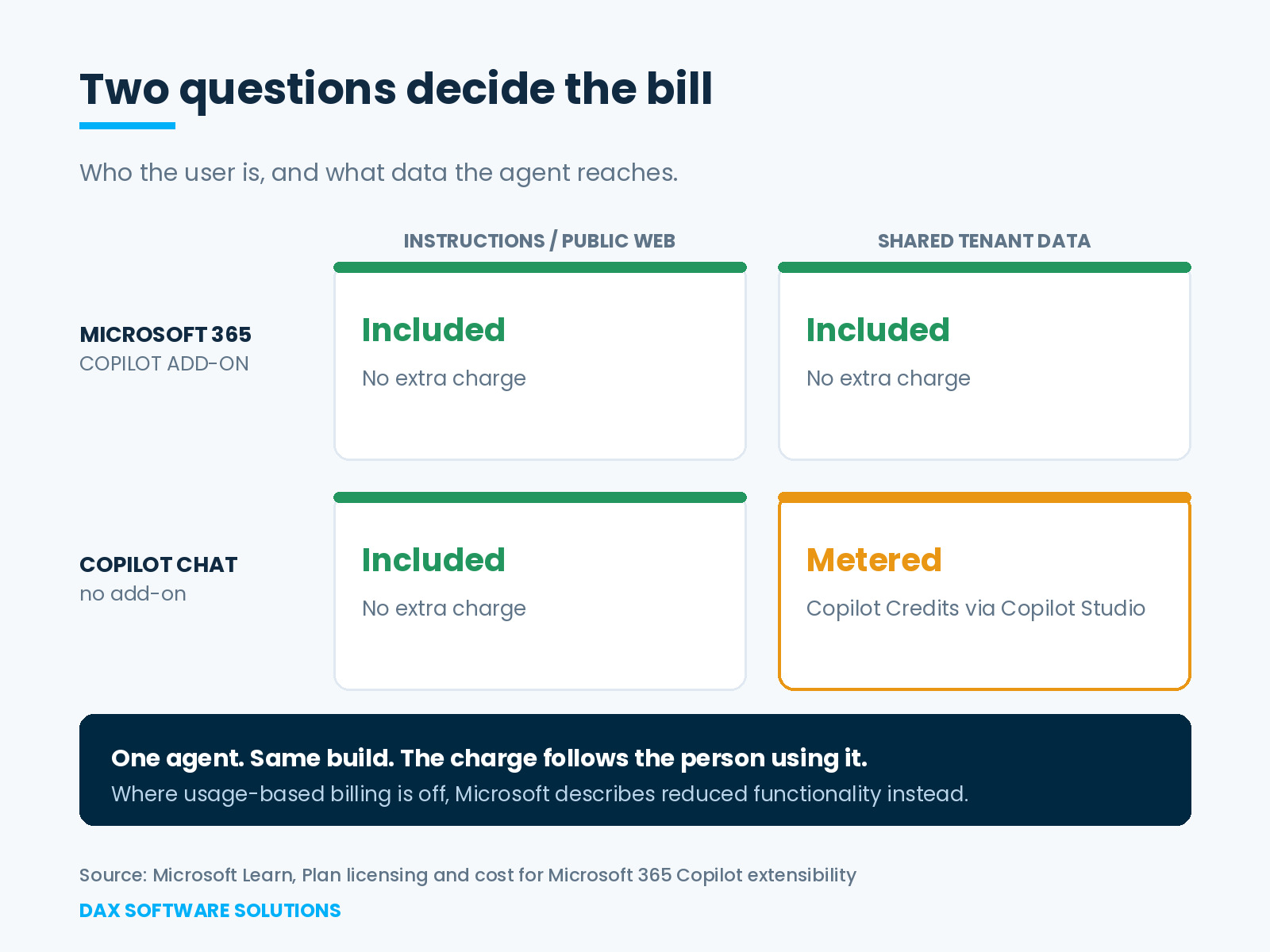
Ask a vendor what a Copilot agent costs and you will get a number. Ask Microsoft’s documentation and you get a decision tree. Copilot extensibility licensing does not price the agent at all. It prices two things about every interaction: who the user is, and what data the agent reaches. Settle those two and the cost follows.
The two questions that decide everything
Microsoft’s cost guidance starts from licence type rather than from features.
Users with the Microsoft 365 Copilot add-on licence sit on the generous side of the line. Microsoft states there are no extra charges for accessing or using extensibility features, and names Copilot connectors, agents and plugins. Users reaching Microsoft 365 Copilot Chat through an eligible Microsoft 365 subscription, without the add-on, sit on the conditional side.
For that second group, grounding decides the outcome. Microsoft states that agents relying on instructions or public website grounding do not incur extra costs. Agents that access shared tenant data, with SharePoint and Copilot connectors named, generate usage-based billing charges metered in Copilot Credits through Copilot Studio.
The same agent can therefore be free for one colleague and billable for the next, with nothing in the build changing.
The sentence most teams skim past
One line in Microsoft’s guidance matters more than the pricing tables around it. If a user does not have a Copilot licence and usage-based billing is enabled in the tenant, using declarative agents might result in consumption charges or limited functionality, depending on how the agent is built.
Read the second half again. Where usage-based billing is not switched on, the cost does not vanish. The capability does.
That reframes the risk. The exposure is rarely a surprise invoice, because finance notices invoices. It is a pilot that performs beautifully for twenty add-on holders and quietly degrades for the four hundred people who come next, in a way that reads to them as a broken product rather than a licensing boundary.
What the flip looks like in practice
Picture a finance policy agent, grounded in a SharePoint library of approval thresholds and expense rules. Nothing exotic, and the kind of thing a capable team builds in a fortnight.
During the pilot it is used by the twelve people who built the business case, all of whom hold the Microsoft 365 Copilot add-on. Microsoft’s position is unambiguous for them. No extra charges for accessing or using extensibility features.
Rollout then extends it to every manager who approves anything. Most of those managers have Copilot Chat through their Microsoft 365 subscription and no add-on. The agent has not changed. The grounding has not changed. But the agent reaches shared tenant data, so for that population the interaction moves onto Copilot Credits through Copilot Studio, or meets reduced functionality where usage-based billing is switched off.
This is what makes Copilot extensibility licensing awkward to forecast. The variable that moves the bill is adoption, and adoption is exactly what the pilot set out to encourage.
Where the add-on genuinely stops
Two capabilities sit outside the pattern above, and Copilot extensibility licensing treats them in opposite ways.
The Microsoft 365 Copilot APIs are available at no additional cost to users holding the add-on, and Microsoft states that support for users without a Microsoft 365 Copilot licence is currently not available. That is a licence gate, not a meter. There is no paid path for users outside the add-on; there is simply no path.
The Work IQ API works the other way. Microsoft describes it as paid for through a consumption-based model that uses Copilot Credits. It is the clearest example of a capability that bills by use rather than by seat, and nothing in the guidance exempts add-on holders from it.
The hosting line nobody budgets for
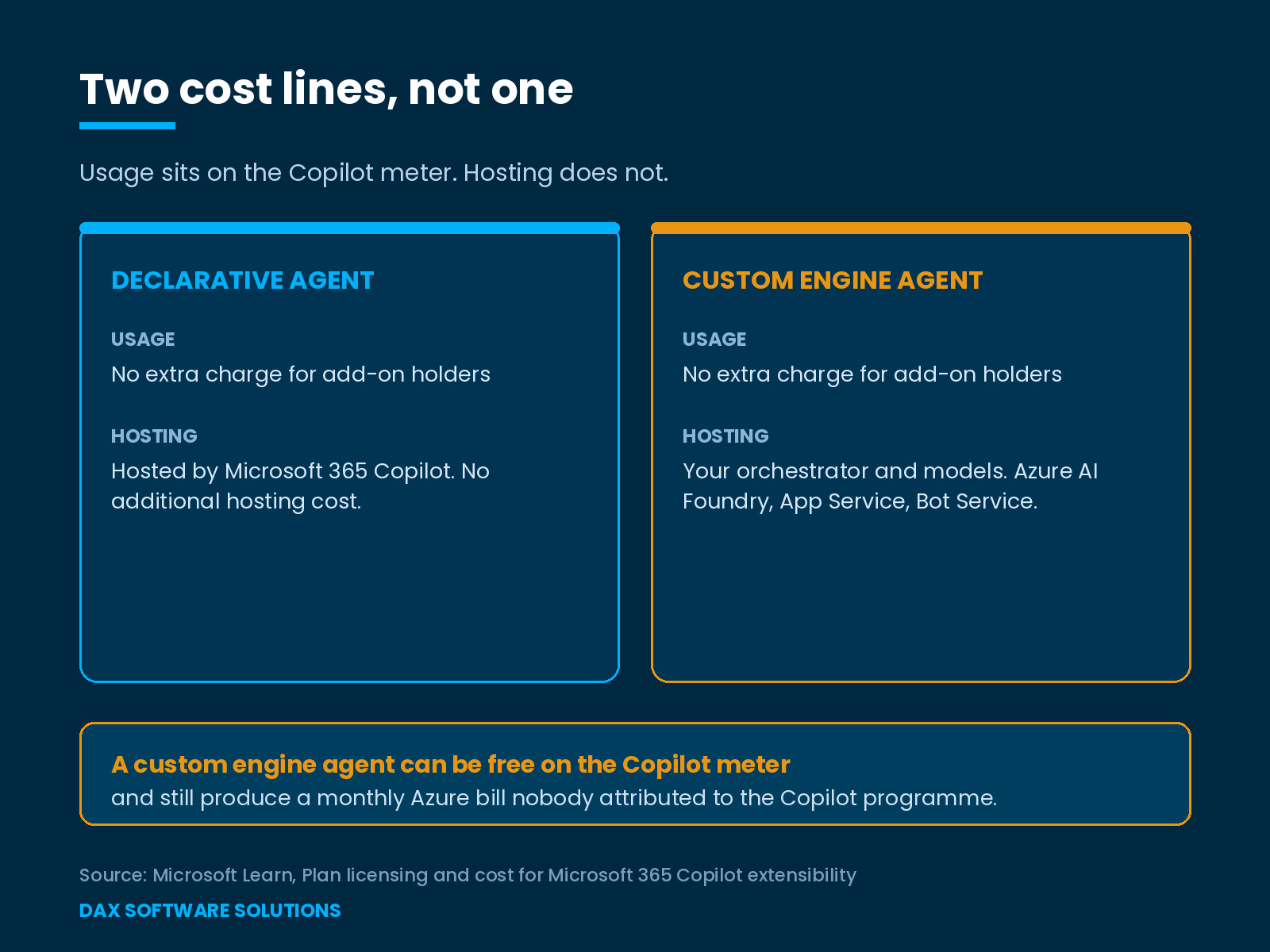
Declarative agents are hosted by Microsoft 365 Copilot and, in Microsoft’s words, do not incur additional hosting costs. That is the comfortable case.
Custom engine agents are a different proposition. They run on your own orchestrator or your own models, and Microsoft names Azure AI Foundry, Azure App Service and Azure Bot Service among the services that may apply. Microsoft adds that total cost varies based on the AI models, orchestration complexity and cloud services you deploy.
So a custom engine agent can be entirely free on the Copilot meter for add-on holders and still produce a monthly Azure bill that nobody attributed to the Copilot programme. Both statements are true at once, which is exactly why the two cost lines need separating in the business case.
Credits behave like capacity, not like a tab
Copilot Credits are easy to picture as a running meter. The Copilot extensibility licensing guidance describes something stricter.
Credits measure the time and effort an agent needs to retrieve information, respond to prompts and use actions or custom skills, and the number counted depends on the complexity of the task. There is no flat per-question rate to multiply across a headcount, which means a credible forecast needs a pilot with real prompts rather than an estimate built in a spreadsheet.
Capacity is enforced monthly, unused credits do not carry over, and Microsoft states that exceeding purchased capacity brings technical enforcement that can result in service denial. This is the same pattern that governs capacity lines elsewhere in the Microsoft estate, and it rewards planning for the peak month rather than the average one.
A Copilot extensibility licensing check before you build
Five questions, answered while the design is still on a whiteboard:
- Which populations will use this agent, and how many of them hold the Microsoft 365 Copilot add-on rather than Copilot Chat access alone?
- Does the agent ground only in instructions and public web content, or does it reach SharePoint content and Copilot connectors?
- Is usage-based billing enabled in the tenant, and if not, which users will meet reduced functionality instead of a charge?
- Is this a declarative agent hosted by Microsoft 365 Copilot, or a custom engine agent whose Azure hosting belongs to us?
- Does the design depend on the Copilot APIs, which are unavailable without the add-on, or on the Work IQ API, which bills by consumption?
Someone usually answers question two in the first week of development, without ever seeing question one.
Why this is a design review, not a procurement exercise
The grounding choice, the agent type and the audience are all engineering decisions, and all three set the bill. That makes Copilot extensibility licensing a subject for the architecture conversation rather than the renewal conversation, in the same way that role design quietly sets a Dynamics 365 licence position.
Microsoft’s extensibility cost guidance is informational and advises confirming final licences, meters and prices against current Microsoft pricing before committing to a design. Entitlement is contractual, so check the specifics with Microsoft or the partner holding your agreement.
At DAX Software Solutions, agentic strategy work starts with the data an agent needs and the people who will use it, because those two answers shape both the architecture and the invoice. If a Copilot agent is moving from pilot to rollout in your organization, a Copilot extensibility licensing review is worth running first. Talk to our team.