
What “AI-Ready” Actually Means for a Dynamics 365 Migration
By DAX Software Solutions ·
“AI-ready” has become the phrase attached to almost every Dynamics 365 migration proposal, and almost none of them define it. It sits in the executive summary as an assumed benefit — move to the cloud, and intelligence follows. The migration gets scoped, budgeted, and approved on the strength of that assumption, and the definition of what “ready” means is quietly deferred until after go-live, when it is far more expensive to fix.
This is the decision that matters, and it rarely announces itself as one. A Dynamics 365 migration is one of the largest and least reversible investments a transformation leader makes, and it is also the single best opportunity to build the foundation that AI depends on. At DAX Software Solutions, we help organizations approach a Microsoft Dynamics 365 migration as the moment to decide AI readiness deliberately — a foundation to construct, not an outcome that arrives on its own.
What “AI-Ready” Actually Means
An AI-ready Dynamics 365 environment is one where trusted data, connected processes, stable operations, and clear governance let intelligence operate safely against the standard platform. That is the whole definition — and if a migration plan cannot point to how it delivers each of those four conditions, it is a technical upgrade wearing an AI label.
Readiness is not a Copilot license or a feature toggle. It is a set of conditions beneath the platform that determine whether intelligence can be used at all. As we often put it: AI doesn’t fix bad data — it exposes it faster. A migration that carries fragmented data forward simply gives that data a newer place to cause problems.
Why the Migration Is the Moment That Decides It
A migration forces decisions that are otherwise easy to defer. Data has to be examined before it moves. Processes have to be documented before they are rebuilt. Integrations have to be re-established rather than inherited. Every one of these is also a prerequisite for AI — which means the migration is the one point in the lifecycle where readiness work is already on the critical path.
Skip it, and the same work returns later at higher cost, because by then the system is live, the data is in production, and the processes are habits. The advantage of deciding readiness during the migration is timing: the organization is already paying to touch every one of these foundations. The choice is whether to do that work once, deliberately, or twice.
The Four Foundations of an AI-Ready Migration
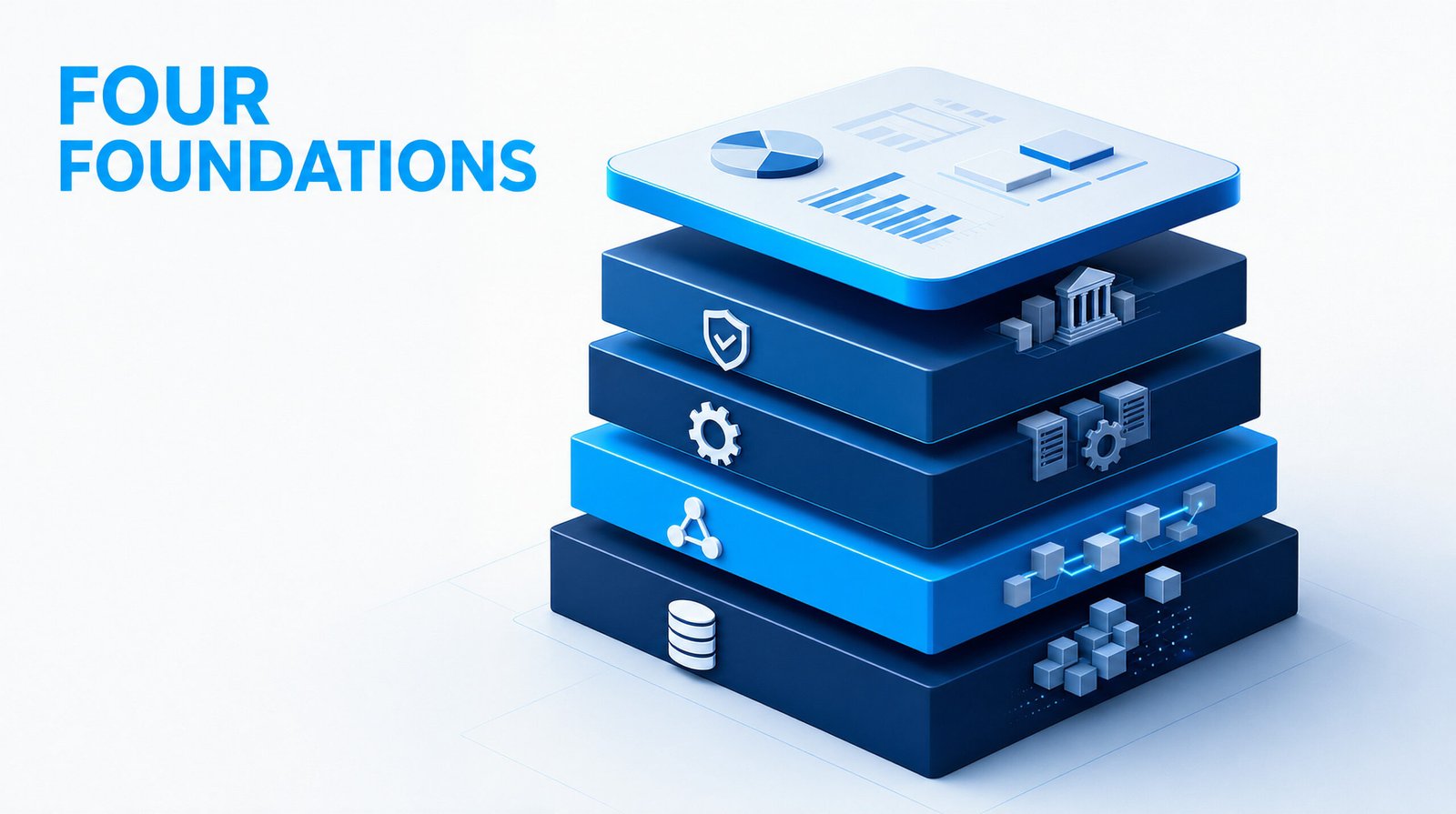
Readiness rests on four foundations, and a migration is where each is either built or bypassed.
- Trusted data — master data that is de-duplicated, consistently defined, and owned, so intelligence reasons over facts rather than noise.
- Connected processes — systems integrated through a deliberate architecture, including platforms such as Aonflow for near real-time synchronization, so decisions carry context across functions.
- Stable operations — processes standardized and running predictably, because automation needs a reliable pattern before it can add value.
- Governance — ownership, controls, and human oversight that define where autonomy is permitted and where judgment stays with people.
Miss any one, and the others cannot compensate. Trusted data on disconnected systems is still trapped; connected systems full of bad data simply spread it faster. This is why integration comes before intelligence.
What Happens When You Skip the Foundations
The temptation is to migrate first and address readiness “when we get to AI.” The results are predictable, and they surface after go-live rather than before it.
- Intelligence with nothing trustworthy to reason over — agents and analytics inherit the same fragmented, duplicated data they always ran on, now in a newer system.
- A second project no one budgeted for — the data, integration, and governance work becomes a separate, later initiative that now lands on a live system.
- Stalled adoption — leadership was promised intelligent operations and receives a faster version of the old system, and confidence erodes.
Readiness deferred is not readiness saved. It is readiness made more expensive.
A Sequenced Path: How to Get There First
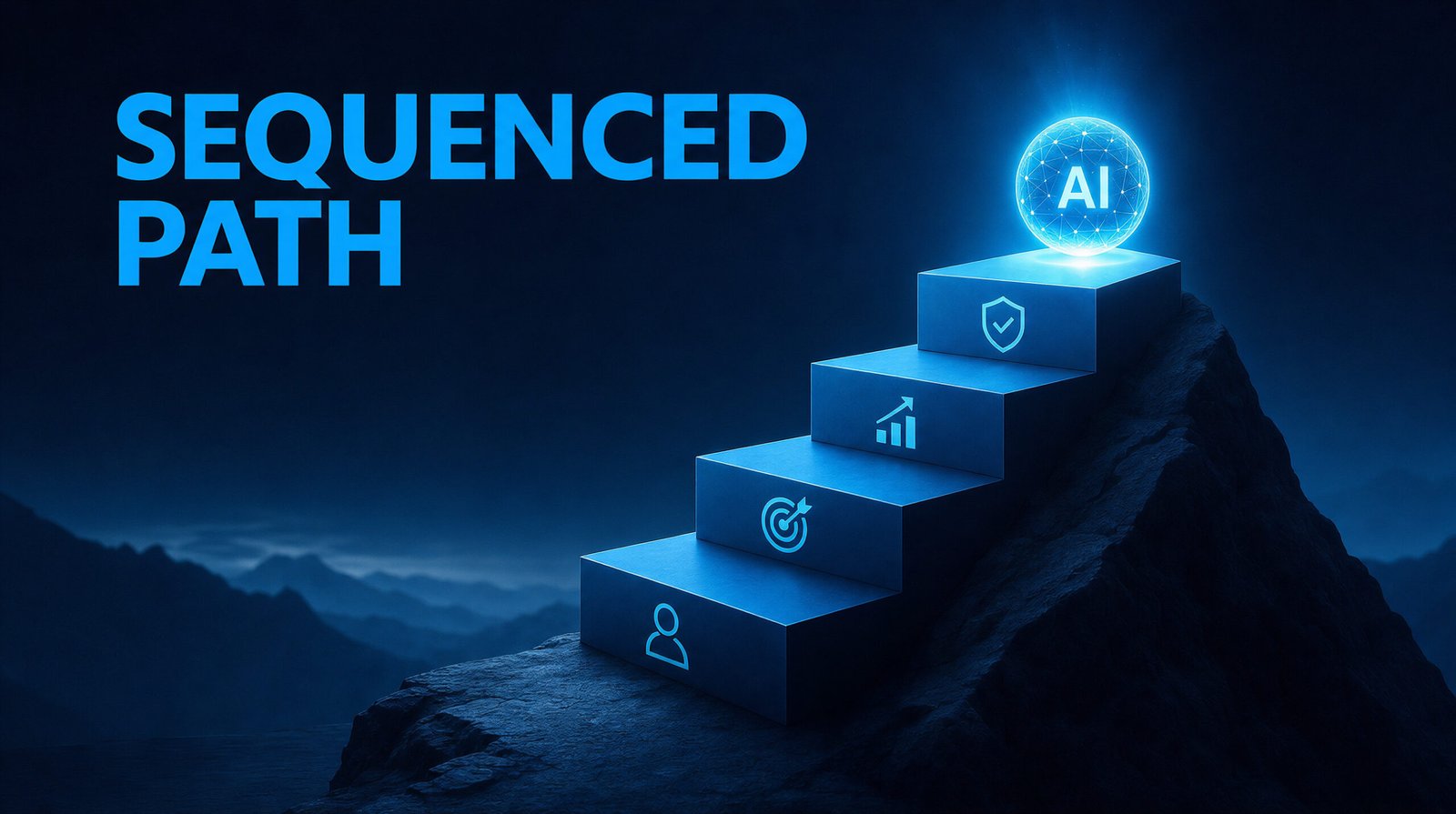
The order is not optional. Getting there first is a matter of sequence and discipline, not speed.
- Assess first — evaluate ERP stability, data quality, integration, and governance before the migration is scoped, so readiness is a known quantity rather than a post-go-live surprise.
- Stabilize the ERP — resolve the process and data issues that would otherwise migrate forward unchanged.
- Govern the data — establish ownership, stewardship, and master-data controls as part of the move, not after it.
- Connect the systems — build the integrations that give each process the context it needs.
- Enable intelligence last — only once the foundation holds does introducing agentic capability make sense.
Doing this work during the migration means doing it once, at the point of greatest leverage. Deferring it means doing it again later, against a live system.
Governance and Human Oversight: The Part That Doesn’t Get Automated
Governance is not the final step; it runs through all of them. Any move toward autonomy has to be paired with human oversight — controlled intelligence, not uncontrolled automation. Frameworks such as the NIST AI Risk Management Framework give leaders a structured way to think about trustworthiness, and a human-in-the-loop operating model keeps people in authority over the decisions that need judgment. Designed in from the start, governance is what lets an organization adopt intelligence with confidence rather than caution.
DAX Software Solutions: Your Partner in an AI-Ready Migration
An AI-ready migration is a decision, made once, at the moment of greatest leverage. DAX helps transformation leaders make it deliberately:
- Assess readiness across ERP stability, data quality, integration, and governance before the move.
- Sequence the foundational work into the migration so it happens once, not twice.
- Pair autonomy with oversight, so intelligence is introduced onto a foundation that can hold it.
ERP is evolving from a system of record to a system of action, and the future belongs to organizations that can turn data into decisions and decisions into action. That future is decided not after the migration, but during it. Talk to DAX Software Solutions about what an AI-ready Dynamics 365 migration looks like for your organization.