

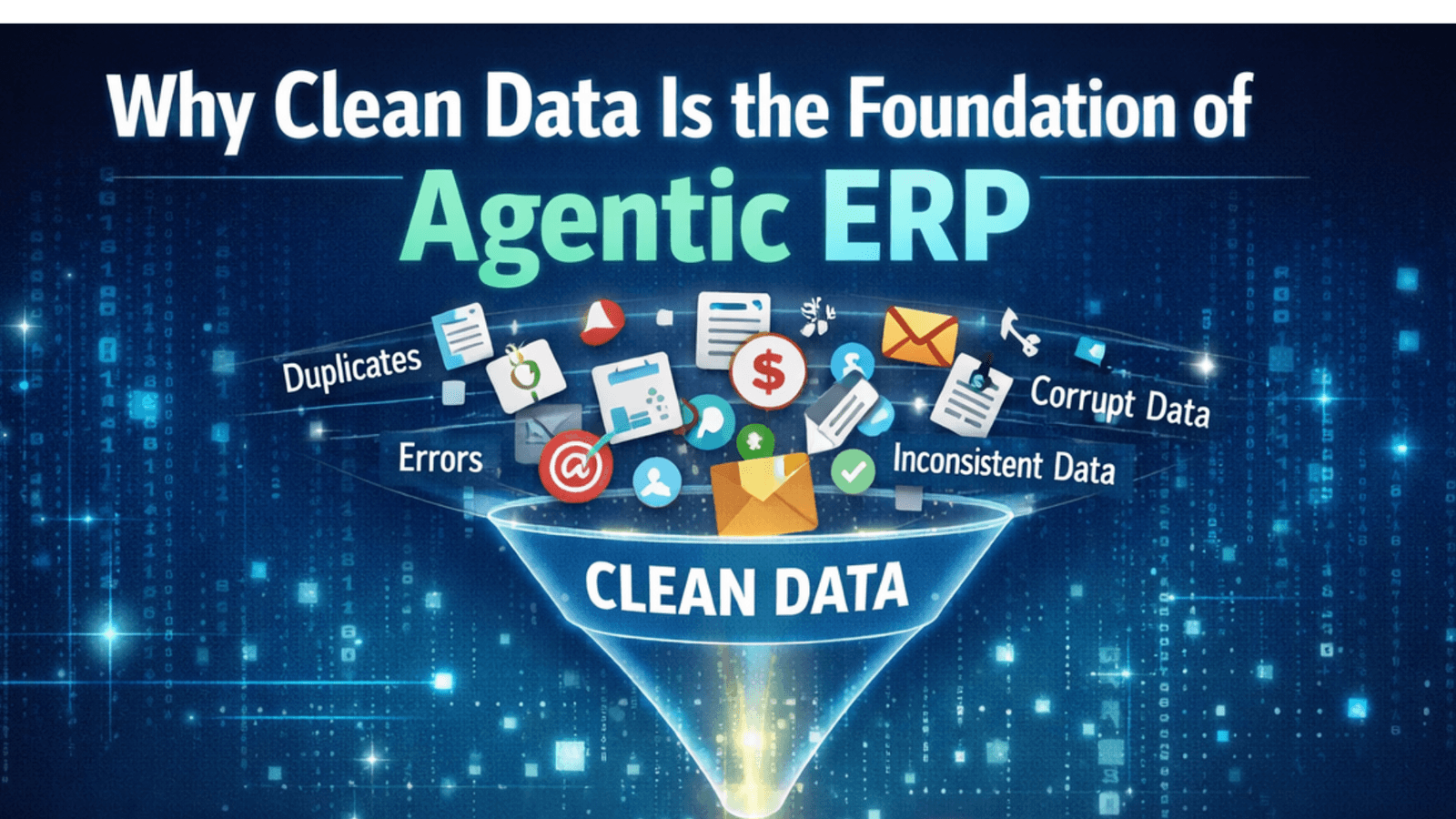
Why Clean Data Is the Foundation of Agentic ERP
Enterprise Resource Planning systems are evolving rapidly with the introduction of artificial intelligence and automation. Organizations are moving toward agentic ERP environments where AI agents monitor operations, analyze data, and execute workflows. However, there is one critical requirement that determines the success of this transformation. Without reliable data, even the most advanced automation systems cannot function effectively. AI agents depend on structured, accurate, and consistent data to make decisions and perform tasks. This is why ERP data governance and ERP data quality are foundational to any agentic ERP strategy.
The Role of Data in Agentic ERP
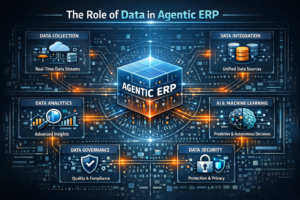
In traditional ERP systems, data is used primarily for reporting and transaction tracking. Users enter information, generate reports, and make decisions based on historical data. In an agentic ERP environment, data plays a much more active role.
AI agents rely on data to:
• evaluate operational conditions
• identify patterns and anomalies
• make decisions within defined rules
• execute workflows across systems
If the data is inaccurate or inconsistent, the outcomes produced by AI agents will also be unreliable. This makes ERP data quality a critical factor in automation success.
What Happens When Data Is Not Clean
Many organizations underestimate the impact of poor data quality on ERP performance.
Common data issues include:
• duplicate records for customers or suppliers
• inconsistent product naming conventions
• missing or incomplete data fields
• outdated information in master data records
In traditional systems, these issues create inefficiencies. In an agentic ERP environment, they create risks.
For example:
An AI agent responsible for procurement may select an incorrect supplier if vendor data is inconsistent. A finance agent may misinterpret transaction patterns if financial data is incomplete.
Poor data quality leads to:
• incorrect automation outcomes
• increased operational errors
• reduced trust in AI systems
• higher compliance risks
This is why clean data is not optional. It is essential.
Master Data Management ERP: The Starting Point
Master data forms the backbone of ERP systems. It includes key business entities such as customers, suppliers, products, and financial accounts. Effective master data management ERP ensures that this information is consistent and reliable across the organization. Key elements of master data management include:
Standardization
Organizations must define consistent formats and naming conventions for data. This ensures that information is uniform across systems.
Centralized Ownership
Each data domain should have clear ownership. For example, procurement teams may own supplier data, while finance teams manage chart of accounts.
Data Synchronization
Master data should be consistent across all connected systems. Integration platforms play an important role in maintaining this consistency. Strong master data management creates a reliable foundation for AI driven processes.
ERP Data Governance: Establishing Control
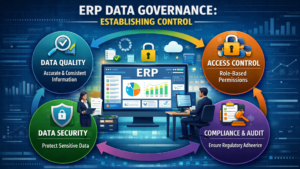
Data governance defines how data is managed, maintained, and protected within an organization. Effective ERP data governance ensures that data remains accurate and trustworthy over time. Key components of data governance include:
Data Ownership
Organizations must assign responsibility for maintaining data quality. This ensures accountability and prevents data inconsistencies.
Data Policies
Clear policies should define how data is created, updated, and validated. These policies guide how users interact with ERP systems.
Access Controls
Data access should be controlled based on user roles. This prevents unauthorized changes and protects data integrity.
Audit and Monitoring
Organizations should regularly review data quality and track changes. This helps identify and resolve issues early.
Governance ensures that data remains reliable as systems evolve.
Data Validation Frameworks: Ensuring Accuracy
Validation frameworks play a key role in maintaining ERP data quality.
These frameworks define rules that ensure data is accurate at the point of entry and during processing.
Examples of validation rules include:
• mandatory fields for critical data
• format validation for identifiers and codes
• cross system checks for consistency
• approval workflows for data changes
Validation reduces the risk of incorrect data entering the system.
It also ensures that AI agents operate on reliable information.
Without validation, data errors can accumulate and impact automation outcomes.
Why AI Depends on Data Quality
AI systems rely on data to learn patterns and make decisions. Unlike traditional automation, which follows fixed rules, AI adapts based on the data it processes.
This makes data quality even more important.
In an agentic ERP environment, AI agents:
• analyze historical and real time data
• identify trends and anomalies
• predict outcomes based on patterns
If the data is incorrect, the insights generated by AI will also be incorrect.
This can lead to poor decision making and operational disruptions.
High quality data ensures that AI agents can perform accurately and consistently.
Building a Data Foundation for Agentic ERP
Organizations must take a structured approach to improving data quality before implementing advanced automation.
Key steps include:
Assess Current Data Quality
Identify existing data issues such as duplicates, inconsistencies, and missing values.
Define Data Standards
Establish clear rules for how data should be structured and maintained.
Implement Governance Frameworks
Assign ownership and define policies for data management.
Introduce Validation Controls
Ensure that data is accurate at the point of entry and during processing.
Monitor and Improve Continuously
Data quality is not a one time effort. Organizations must continuously monitor and refine data processes. These steps help create a strong foundation for master data management ERP and intelligent automation.
Benefits of Clean Data in Agentic ERP
Organizations that prioritize data quality gain several advantages.
Reliable Automation
AI agents can execute workflows accurately when data is consistent.
Improved Decision Making
High quality data leads to better insights and more informed decisions.
Increased Efficiency
Clean data reduces the need for manual corrections and rework.
Stronger Compliance
Accurate data supports regulatory requirements and audit processes.
Greater Trust in Systems
Users are more likely to rely on ERP systems when data is reliable. These benefits support successful ERP data governance and long term transformation.
The Future of Data Driven ERP Systems
As ERP systems become more intelligent, the importance of data will continue to grow.
Future ERP environments will rely on:
• real time data processing
• integrated data across systems
• advanced analytics and AI models
• automated decision making
Organizations that invest in data quality today will be better positioned for this future. Clean data is not just a technical requirement. It is a strategic asset.
Conclusion
Agentic ERP represents a significant shift in how enterprise systems operate. AI agents can monitor processes, analyze data, and execute workflows. However, their effectiveness depends entirely on the quality of the data they use. Strong ERP data governance, effective master data management ERP, and robust validation frameworks are essential for success. Organizations that prioritize ERP data quality will unlock the full potential of intelligent automation. Those that neglect it risk amplifying operational challenges. Clean data is not just the foundation of agentic ERP. It is the foundation of modern enterprise success.