

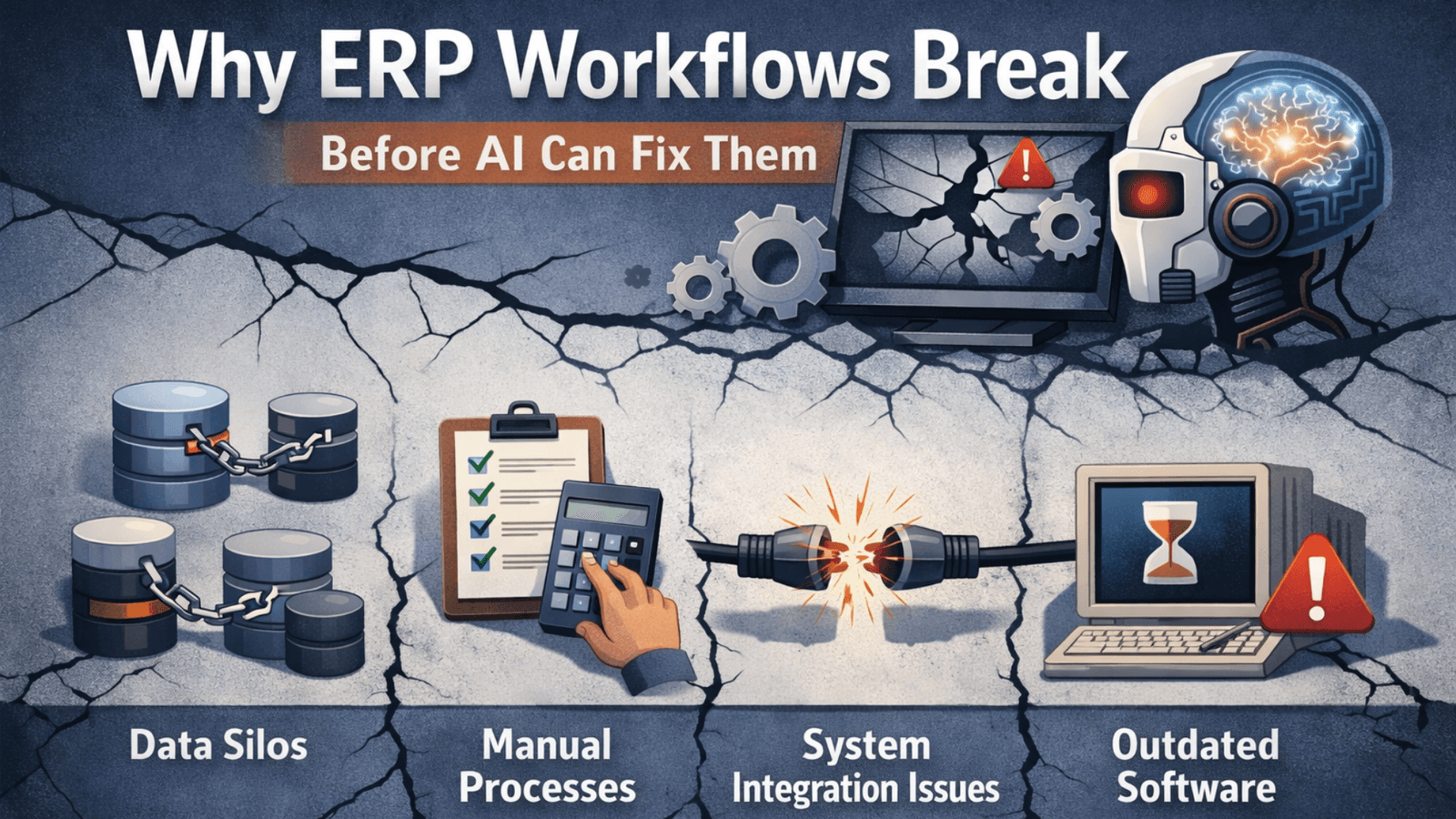
Why ERP Workflows Break Before AI Can Fix Them
Agentic AI ERP is gaining momentum as organizations look to automate decisions and enable intelligent operations across finance, supply chain, and customer processes. However, one critical misconception continues to derail transformation efforts. Many organizations assume AI will fix inefficiencies in ERP workflows. The reality is the opposite. AI amplifies what already exists.
If your ERP workflows are fragmented, poorly governed, or dependent on manual overrides, introducing AI agents in ERP will not solve the problem. It will scale the chaos. Instead of improving operations, AI will accelerate errors, inconsistencies, and inefficiencies. Understanding why ERP workflows break before AI can fix them is essential for any organization planning to adopt ERP AI automation.
The Foundation Problem: Broken Workflows Cannot Support AI

ERP systems are fundamentally designed to enforce structure, consistency, and control across business operations. Over time, however, organizations often introduce workarounds, manual overrides, and disconnected processes that gradually erode this foundation. These gaps may remain hidden during day-to-day operations but become highly visible once AI is introduced. When AI agents begin interacting with ERP workflows, they depend on consistent process logic, accurate data, and clearly defined decision paths. If these elements are missing, AI cannot operate effectively.
Instead of improving decision-making, optimizing workflows, and reducing manual effort, the outcome shifts in the opposite direction—leading to incorrect automation, unreliable outputs, and increased operational risk. In such environments, AI does not fail on its own; it exposes the weaknesses already present in the system. This is why ERP transformation must focus on strengthening the foundation first, ensuring that AI is applied to stable, well-governed processes where it can deliver measurable and trustworthy value. This is why ERP workflows must be stabilized before introducing agentic AI ERP capabilities.
Common Reasons ERP Workflows Break
Most organizations face similar challenges in their ERP environments. These issues accumulate over time and create a fragile operational foundation.
- Duplicate Data Across Systems
Data fragmentation is one of the most common problems. When ERP, CRM, and other systems are not properly integrated:
- customer records are duplicated
- financial data becomes inconsistent
- inventory levels do not align
AI agents in ERP depend on accurate, unified data. If multiple versions of the truth exist, AI cannot make reliable decisions.
- Inconsistent Approval Processes
Approval workflows are often loosely defined. Examples include:
- approvals handled through email instead of ERP
- different rules applied across departments
- unclear escalation paths
Without standardized approval logic, AI cannot determine:
- when to approve
- when to escalate
- when to stop a process
This leads to unpredictable outcomes.
- Lack of Ownership in Workflows
Many ERP workflows lack clear ownership. This creates:
- delays in decision-making
- unresolved exceptions
- inconsistent accountability
AI agents require defined ownership structures to operate within business rules. Without ownership, decision logic becomes ambiguous.
- No Standardized Data Governance
Data governance is often overlooked until it becomes a problem. Common issues include:
- inconsistent naming conventions
- missing data validation rules
- lack of data stewardship
Without governance, data quality deteriorates over time. For ERP AI automation to work, data must be:
- accurate
- standardized
- continuously maintained
Otherwise, AI outputs become unreliable.
Why AI Amplifies These Problems
AI does not fix broken systems. It operates within the constraints of the system it is deployed in.
If your ERP environment has:
- poor data quality
- inconsistent workflows
- weak governance
AI will:
- process incorrect data faster
- execute flawed decisions at scale
- increase operational risk
For example: An AI agent designed to automate invoice approvals may approve incorrect invoices if:
- data is inconsistent
- approval rules are unclear
- validation checks are missing
This is why organizations must shift their mindset. AI is not a repair tool. It is an acceleration layer.
What ERP Needs Before AI Can Work
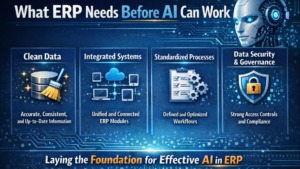
Before implementing agentic AI ERP, organizations must establish a strong foundation.
- Structured Workflows
Workflows must be clearly defined, standardized across departments, and tightly aligned with business objectives to support effective ERP execution. When processes vary or lack structure, they introduce ambiguity that limits both automation and AI effectiveness. Each step in a workflow should therefore be explicitly designed with a defined input, a clear action, and an expected outcome. This level of precision creates a predictable and controlled operating environment, enabling AI agents to function with consistency, accuracy, and accountability while driving meaningful operational value.
- Clean Master Data
- Defined Decision Boundaries
- Controlled Exception Handling
Exceptions are where most ERP processes break down—not in the standard flow, but in the edge cases that lack structure and ownership. When exceptions are left unmanaged, they create bottlenecks, data inconsistencies, and operational risk. Organizations must therefore treat exception handling as a core design component by defining clear exception workflows, assigning ownership, and establishing structured resolution paths. Once this foundation is in place, AI agents can operate with purpose—identifying exceptions in near real-time, routing them to the right stakeholders, and assisting in resolution with contextual intelligence. This is where AI delivers meaningful value: not by replacing control, but by strengthening it where systems are most vulnerable.
The Role of Governance in Agentic AI ERP
Governance is the most critical component of successful ERP AI automation. It ensures that:
- decisions follow business rules
- actions are auditable
- risks are controlled
Key governance elements include:
- approval frameworks
- audit trails
- role-based access control
- policy enforcement
Without governance, AI becomes unpredictable. With governance, AI becomes reliable.
A Practical Approach to AI-Ready ERP
At DAX Software Solutions, we take a structured approach to implementing agentic AI ERP. We do not start with AI.
We start with:
- ERP stabilization
- workflow standardization
- data governance
- system integration
Only after these foundations are in place do we introduce:
- AI agents in ERP
- Copilot capabilities
- intelligent automation
This ensures that AI operates within a stable and controlled environment.
From Chaos to Controlled Intelligence
Conclusion
ERP workflows often break before AI can fix them—not because AI is ineffective, but because the underlying processes were never designed for intelligent automation. AI does not correct flawed systems; it amplifies them. When workflows are unstable, data is inconsistent, and governance is weak, introducing AI only accelerates errors, creating faster but more costly failures. To truly unlock the value of AI-driven ERP automation, organizations must first stabilize their workflows, ensure high-quality and reliable data, establish strong governance frameworks, and clearly define decision boundaries. Only with this foundation in place can AI agents operate with precision, consistency, and accountability. At DAX Software Solutions, we help organizations build AI-ready ERP environments that enable intelligent automation and drive sustainable, long-term transformation.
Contact us: https://daxsws.com/contact-us